

I wore my grandmother’s saree to my cousin’s mehndi last spring and I stood in front of the mirror for twenty minutes trying to write a caption before I gave up and just posted “wearing her, wearing me.” That line worked because it was specific to that saree and that woman, not because it was clever. Most traditional captions for Instagram fail for the opposite reason.
They’re written to fit any traditional outfit, on any occasion, for anyone, which means they end up fitting nothing in particular. This list is built around real moments instead, so you can find a line that actually matches what you’re wearing and why, whether you’re looking for captions for traditional look, traditional quotes for instagram or quotes for traditional look.
Traditional Wear Captions for Weddings and Family Occasions
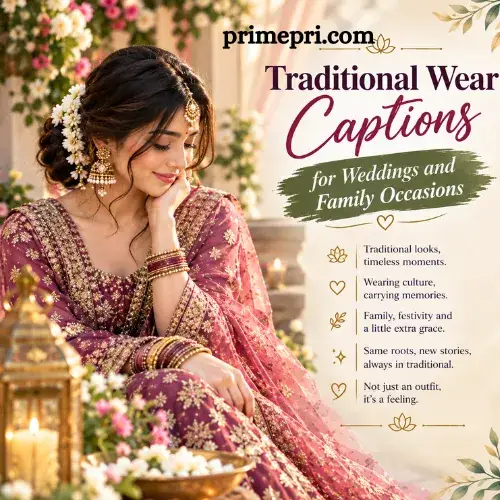
- “Borrowed this saree from my mother and I think it borrowed some of her grace too.” For a wedding where you’re wearing a family heirloom piece, not something bought for the event.
- “My nani picked this color for me before I was even born.” For an outfit color chosen by an older relative, referencing the intention behind it rather than the fabric.
- “Third generation to wear this dupatta at a wedding. I’ve seen more love stories than I have.” For a specific inherited item with documented family history, like a dupatta or veil passed down.
- “Getting ready with the aunties this morning was louder and better than the wedding itself.” For a mehndi or sangeet morning where the getting-ready process, not just the outfit, was the moment.
- “Dressed for a wedding that isn’t mine, dancing like it might as well be.” For a guest at a cousin’s or close friend’s wedding, capturing the specific energy of celebrating someone else’s day.
- “My dad still calls this ‘the good kurta.’ He’s not wrong.” For a men’s traditional outfit with a small, specific family nickname or history attached to it.
- “First time wearing a lehenga without my mom pinning it for me.” For someone dressing independently in traditional wear for the first time, a genuine milestone line.
- “This sherwani belonged to my uncle in 1998. Slightly tighter fit, same amount of confidence.” For men reusing an older relative’s outfit, acknowledging the fit honestly instead of pretending it’s new.
- “Every fold in this saree took forty minutes and one very patient aunt.” For a post about the actual process of draping a saree, not just the finished look.
- “Wore red because that’s what she wore. Some things you don’t update.” For someone deliberately choosing a traditional color over a trendier one, out of specific homage.
Captions for the Traditional Look Nobody’s Grandmother Approved Of

Most lists stop at “respectful heritage” language and skip the fact that a lot of traditional dressing today is a deliberate remix, not a copy. These fit that.
- “Told my mother I was wearing this with sneakers. She’s still not over it.” For pairing traditional wear with a modern element that got family pushback.
- “Tradition, but make it mine.” For someone who altered a traditional silhouette (shorter hem, different draping, added a jacket) rather than wearing it exactly as intended.
- “My outfit is 200 years of tradition and one very stubborn opinion about sleeves.” For a piece that’s been customized in a specific, personal way.
Short Traditional Captions for Instagram
- “Draped, not designed.” For a simply styled saree post with minimal accessories.
- “Old thread, new confidence.” For a well worn or inherited piece worn with visible pride.
- “Still fits, still hers.” For wearing an item that literally belonged to a parent or grandparent, still in its original form.
- “Color of the day: whatever my dad chose.” For a look where the palette wasn’t your decision.
- “Simple. Sacred. Mine.” For traditional wear tied to a religious occasion rather than a wedding or festival.
Traditional Captions for Festivals and Religious Occasions
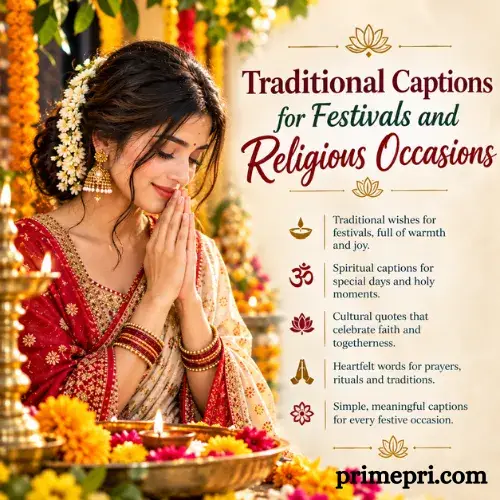
- “Diyas lit, phone charged, grandmother watching everything I do wrong with the aarti.” For a Diwali post that includes the specific, slightly chaotic reality of the ritual, not just the aesthetics.
- “My Eid outfit is new. My prayers are the same ones my father taught me.” For an Eid caption connecting the clothing to something learned from a specific person, not just the day.
- “Puja at 6am means my kurta smells like incense for the rest of the day and I don’t mind.” For a specific, sensory detail from a religious morning that most captions skip entirely.
- “First Navratri in this dress, ninth in this family.” For a new outfit worn within a long running family tradition, contrasting the newness of the item with the age of the tradition.
- “Wore green because it’s what she wears every Eid. Small ways of staying close to her.” For someone continuing a specific relative’s color or style choice after a loss or distance, without overstating the emotion.
What I’ve Learned Writing These Captions for Years
The biggest mistake I see, including ones I’ve made myself, is treating “traditional” as one mood instead of a spectrum. A saree caption for your own wedding and a saree caption for your cousin’s cultural day at college should never sound the same, but most caption lists give you the exact same twelve lines regardless of the occasion.
The second mistake is over-explaining the outfit’s cultural significance in the caption itself, as if the reader needs a history lesson before they’re allowed to like the photo. A short, specific, personal line almost always outperforms an educational paragraph, because it invites people into a moment instead of lecturing them about heritage. The third thing worth knowing: captions that reference a specific person (a grandmother, a mother, an aunt who did your hair) get noticeably more comments than generic “embracing my roots” lines, because they give people something concrete to respond to. If you’re stuck, name the person or the specific object, not the abstract idea of tradition.
Where the Word “Traditional” Actually Comes From and Why It Shifts by Relationship
“Traditional” in this context almost always refers to region specific attire, most commonly South Asian formal wear like sarees, lehengas, kurtas and sherwanis, tied to weddings, religious festivals or family gatherings. The tone of a good caption changes depending on who’s actually going to read it. A caption for a post your parents and their friends will see (a wedding, a puja, a family portrait) usually works better in a slightly formal, respectful register, closer to the “third generation to wear this” style above.
A caption for a post mostly seen by your own friends (a mehndi, a cultural club event, a casual festival hangout) can be looser and more playful, closer to the “she’s still not over it” style. Mixing a native language phrase or word into an English caption, when it’s genuine to how you’d actually say it, usually reads as more authentic than translating everything into English for a wider audience. Forcing it in when it’s not natural to you tends to read the opposite way.
How to Personalize These for Your Own Post
Swap the specific relative, object or number of years for your own details before posting, since the specificity is what makes these work in the first place. If you’re wearing something bought rather than inherited, don’t force an heirloom angle, use a line about the color choice, the occasion or who helped you get ready instead.
If the outfit was your own styling decision that broke from tradition slightly, say so directly rather than pretending it’s purely classic, since that honesty tends to read better than an overly reverent caption for a modern remix.
FAQs
What should I caption a picture of myself in traditional wear?
Name one specific detail, either the person connected to the outfit, the occasion or how you altered it, rather than a general statement about heritage. A caption built around your grandmother’s saree, a specific festival morning or a deliberate styling choice will read as more personal and get more engagement than a broad “tradition never goes out of style” line.
How do I make a traditional outfit caption sound less generic?
Replace abstract words like heritage, roots and timeless with a concrete detail such as a name, a year or a small specific moment from getting ready. Generic captions describe the category of the outfit. Specific captions describe your outfit, on that day and that difference is what readers actually respond to.
Are there good short captions for traditional Indian outfits?
Yes, short captions work well when they pair one concrete image with a few words, such as “still fits, still hers” or “old thread, new confidence,” instead of trying to summarize the outfit’s full cultural meaning in one line. Short captions rely on the photo to carry the visual weight and the words to carry the personal detail.
Should traditional wear captions include hashtags?
A few relevant, specific hashtags help with discovery, but they shouldn’t replace the caption itself or repeat what the caption already says. Two or three well chosen hashtags tied to the specific occasion, region or outfit type generally perform better than a long generic block of heritage related tags.
How do I caption traditional wear respectfully if it’s not from my own culture?
Credit the specific culture, occasion or designer by name rather than using vague cultural language and avoid presenting the outfit as a costume or aesthetic trend. If you’re unsure about appropriate context, a simple, factual caption naming the origin of the outfit is safer than an overly poetic or vague one.
Conclusion
That mehndi night saree caption still gets the occasional comment from cousins who remember my grandmother wearing it themselves and that’s really the whole point.A traditional caption doesn’t need to explain tradition. It just needs to be true to the one specific moment you’re actually in. traditional captions for instagram traditional captions captions for traditional look for girls.
